The landscape of American education is currently facing its most significant shift since the invention of the internet. With the explosion of automated text generators, students and researchers are at a crossroads. It has never been easier to produce a thousand words with the click of a button, yet it has never been more difficult to produce an original thought. As universities across the US—from the Ivy League to community colleges—tighten their policies on academic honesty, a vital distinction has emerged: the difference between mere “content generation” and true “human synthesis.”
In this evolving environment, the demand for genuine expertise is higher than ever. While software can string sentences together, it often lacks the nuanced understanding required for complex assignments, which is why many students look for a professional academic consultant or essay helper from a trusted platform like myassignmenthelp to understand how to structure their own original arguments. This human-to-human collaboration ensures that the final output isn’t just a collection of facts, but a cohesive piece of critical analysis that meets the rigorous standards of modern scholarship.
The Mechanism of Critical Thinking: More Than Just Logic
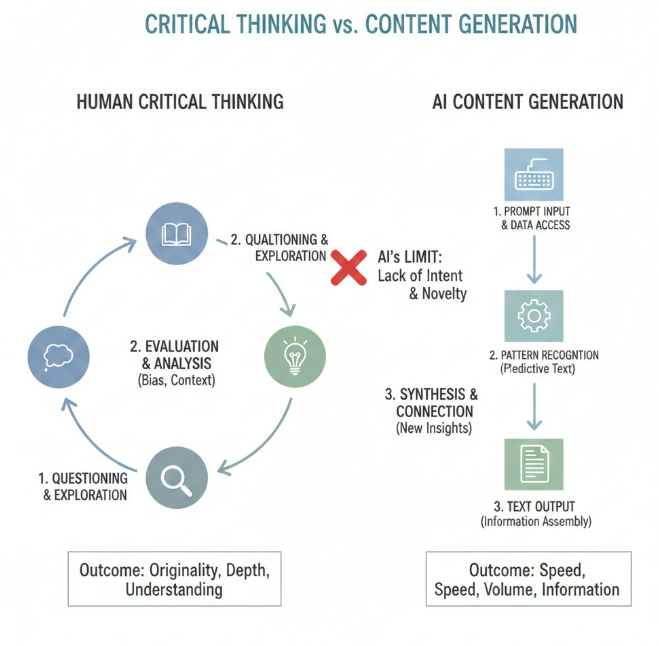
Critical thinking isn’t just about finding the right answer; it’s about asking the right questions. When a student in the US approaches a prompt—whether it’s for a Common App essay or a senior thesis—they are performing a series of high-level cognitive tasks that machines simply cannot replicate. They are evaluating the reliability of a source, identifying the subtle biases of an author, and considering the historical context of a specific theory.
In a US classroom setting, a 12th grader or a college freshman is expected to demonstrate what educators call “rhetorical awareness.” This means understanding who the audience is and why a specific tone matters. For example, writing a lab report for a Biology professor requires a completely different “voice” than writing a persuasive piece for a Political Science seminar. A machine might use a word that is technically correct but emotionally or contextually tone-deaf. Human synthesis, however, allows the writer to weave together disparate ideas into a “EUREKA” moment that provides a fresh perspective on an old problem.
The Limits of Content Generation: The “Hallucination” Problem
Generative tools work on probability, not logic. They are essentially sophisticated “predictive text” engines. They predict the next likely word in a sentence based on massive datasets they were trained on years ago. This often leads to what researchers call “hallucinations”—a polite term for the software confidently making things up. In academic writing, where a single misattributed quote or a fake statistic can lead to a failing grade or a disciplinary hearing, the risks of relying solely on automation are far too high.
Furthermore, content generation produces “flat” writing. It lacks the unique “voice” that teachers look for when grading. When a professor reads a paper, they aren’t just looking for a data dump; they are looking for the student’s intellectual growth. They want to see the struggle with the material and the eventual mastery of the topic. If an essay reads like a Wikipedia entry, it fails the “So What?” test—the fundamental US academic requirement to prove why your argument matters in the real world.
Why Synthesis is the Gold Standard in US Education
Synthesis is the process of combining ideas from different sources to create something entirely new. It is the backbone of the American “Liberal Arts” tradition. It requires the writer to see the “invisible threads” between a political event in the 1920s and a social movement in 2026. This isn’t just summarizing; it’s building a mental bridge.
To truly master this skill, students often search for guides on How to Write a Synthesis Essay to learn how to organize their evidence without losing their own unique voice in the process. This specific type of writing is often the final hurdle for graduating seniors, as it proves they can think for themselves rather than just repeating what they’ve been told.
The “Human-In-The-Loop” Necessity
Even in professional research environments, the concept of “Human-in-the-Loop” (HITL) is becoming the standard. This means that while technology can help gather data, a human must be the one to interpret it. Why? because humans understand intent.
Consider a research paper on the economic impact of local farmers’ markets in California. An AI might find data on sales taxes and vendor counts. However, a human writer understands the cultural significance of “community gathering spaces” and the psychological impact of “farm-to-table” movements on local identity. That “cultural layer” is what earns an ‘A’ grade in a high-level US university course. It shows that the writer isn’t just a passive observer but an active participant in the culture they are analyzing.
Navigating the Ethics of Academic Support
There is a significant difference between using a tool to bypass learning and using a service to enhance it. The most successful students use academic support as a roadmap. By looking at high-quality examples of synthesis, they learn how to cite sources correctly using APA or MLA formats, how to build a logical bridge between paragraphs, and how to maintain a formal academic tone.
Ethical academic help serves as a bridge. It provides the “scaffolding” that helps a student climb to a higher level of understanding. This is why human-led services are thriving even in the age of AI; the human element provides a level of accountability, empathy, and accuracy that an algorithm simply cannot promise. A human mentor understands that a student might be struggling because they are a non-native English speaker or because they are balancing a part-time job with a full course load. An AI doesn’t care; a human expert does.
Structural Integrity: The Anatomy of a High-Scoring Essay
To rank well and perform well in a classroom, an essay must follow a specific structural logic that US graders expect. This structure is designed to guide the reader through a complex argument without causing “cognitive overload.”
- The Hook and Context: You must ground your topic in a current reality.
- The Nuanced Thesis: Avoid “Black and White” thinking. A strong thesis acknowledges the complexity of the topic.
- The Evidence Matrix: Every claim must be backed by a credible source (like a .gov or .edu site).
- The Counter-Argument: This is the ultimate sign of critical thinking. By acknowledging the “other side,” you actually make your own argument stronger.
- The “So What?” Conclusion: Don’t just summarize. Tell the reader why your findings change the way we should look at the world.
Future-Proofing Your Academic Career
As we move further into the 2020s, the “skill” of writing will become less about the act of typing and more about the act of editing, verifying, and synthesizing. The students who succeed in the future US job market—whether in law, medicine, or tech—will be those who can take a raw draft and apply a layer of human “polish” and critical thought to it.
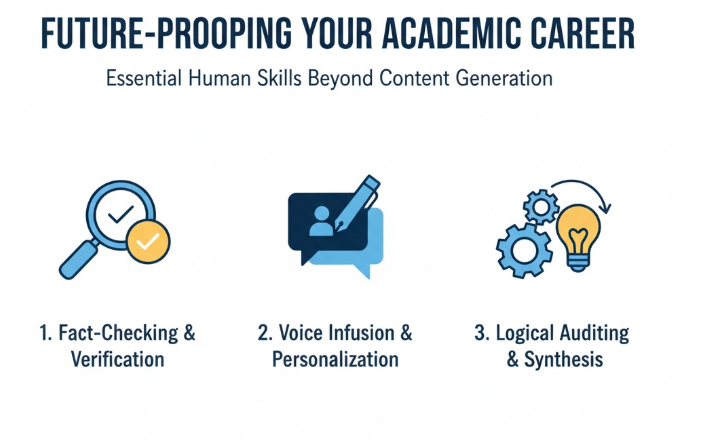
To stay ahead, students should adopt these three habits:
- Fact-Checking: Always verify every date, name, and citation against a primary source.
- Voice Infusion: Use personal anecdotes or specific classroom examples to prove the work is unique to your experience.
- Logical Auditing: Ensure that your conclusion actually follows from your premises—don’t let a machine jump to conclusions for you.
The Psychological Benefit of Writing by Hand (or Heart)
There is also a psychological component to consider. Studies in educational psychology suggest that the process of synthesizing information helps with long-term retention. When you “content generate,” you aren’t learning; you are simply “outsourcing” your brain. When you engage in human synthesis, you are building neural pathways that improve your memory and your ability to speak articulately in public settings. This is the “hidden curriculum” of writing—it makes you a smarter person, not just a person with a finished paper.
Conclusion: The Human Advantage
Ultimately, academic writing is a conversation between the past and the present. It is a way for us to contribute to the global library of knowledge. While technology can help us organize our thoughts or fix our grammar, the “soul” of the essay—the synthesis of ideas—must come from a human mind.
By prioritizing critical thinking over easy generation, students ensure that their degrees represent not just a piece of paper, but a genuine capacity for thought. In an era of infinite content, the only thing that will remain truly valuable is the human perspective.
Frequently Asked Questions
1. How can I balance using AI tools with my own human creativity?
The most effective way is to use a “human-first” workflow. Start by brainstorming your core ideas and drafting a messy first version without any digital help. Once your unique perspective is on paper, you can use tools to help with transitions or grammar. By treating technology as a “junior assistant” rather than the “lead author,” you ensure your personal voice stays at the center of the work.
2. Why can’t I just use AI to write my synthesis essay?
While AI can gather facts, it lacks the ability to understand “intent” and “cultural nuance.” Synthesis requires you to find relationships between sources and create a new perspective. AI often “hallucinates” (makes up) facts or produces “flat” writing that fails to demonstrate the intellectual growth professors look for in US colleges.
3. What is the most important part of learning how to write a synthesis essay?
The most important part is the thesis statement. Unlike a summary, a synthesis thesis must bridge the gap between multiple viewpoints to offer a fresh insight. It proves that you haven’t just read the material, but that you have critically analyzed how the different ideas interact with one another.
4. How can I prove to my professor that my work is original human synthesis?
The best way is to “show your work.” Keep your early outlines, drafts, and lists of sources. Adding personal voice, specific classroom examples, or unique connections to current US events are “human markers” that AI cannot easily replicate. This transparency builds the E-E-A-T (Expertise and Trustworthiness) that modern educators value.
About The Author
Zara Williams is a senior academic consultant and educational researcher specializing in US higher education trends. With over a decade of experience in pedagogical development, Zara Williams on helping students bridge the gap between digital tools and traditional critical thinking. She currently collaborates with the expert team at myassignmenthelp to advocate for academic integrity and the preservation of human-led synthesis in a rapidly evolving technological landscape.