Google started banning users. Not bots. Not scrapers. Paying customers. Their offense? Connecting OpenClaw – the open-source AI agent framework with 230,000+ GitHub stars – to Google’s Antigravity backend and letting it run autonomously. The agents consumed API resources at rates that made human usage look like a rounding error, and Google decided the simplest fix was to cut those users off entirely.
This wasn’t a bug. It was a pricing model meeting reality.
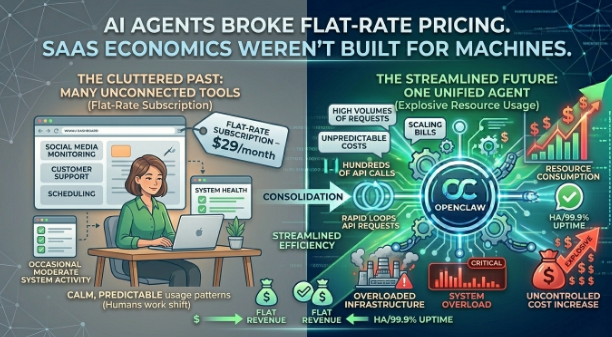
Every SaaS product with a flat-rate or per-seat subscription was priced with an implicit assumption: humans use software at human speed. We take breaks. We read screens. We get distracted by Slack. An AI agent does none of these things. It makes API calls continuously, processes data in loops, and never sleeps. When thousands of users pointed OpenClaw at services they were already paying for, the math collapsed overnight.
SaaS Subscriptions Were Priced for Humans. Agents Aren’t Human.
The analysis “AI Subscriptions Were Priced for Humans” went viral for a reason – it quantified what builders were already experiencing. A single OpenClaw agent interacting with a typical SaaS API can generate 10–50x the request volume of its human operator. Multiply that across thousands of users, and the provider’s infrastructure costs spike while revenue stays flat.
This is the same economics problem that killed unlimited storage plans and all-you-can-eat API tiers. But it’s happening faster because agent adoption is exponential. OpenClaw alone has 44,000+ forks. The framework connects to 15+ chat platforms and supports 28+ AI model providers. Every one of those connections represents a potential consumption spike that the connected service didn’t price for.
Here’s the part nobody mentions.
The providers getting hit hardest aren’t the ones with usage-based pricing. Stripe, Twilio, AWS – they’re fine. Every agent API call generates revenue. The companies in trouble are the ones offering per-seat flat rates with backend costs that scale with usage. Project management tools. CRM platforms. Email services. Calendar apps. Their margins assumed a human clicking buttons, not an agent making 200 API calls per minute.
The Three Pricing Models That Don’t Survive Agents
Flat-rate unlimited. Dead on arrival. If your plan includes “unlimited API calls” or “unlimited automations,” an AI agent will find that limit for you. Google’s Antigravity bans proved this in public. Countless smaller providers are discovering it in their AWS bills.
Per-seat licensing. Mortally wounded. One seat with an OpenClaw agent attached generates the load of 10–50 human seats. Enterprise SaaS vendors selling per-seat deals are watching their gross margins evaporate as customers deploy agents that technically count as one user but consume resources like fifty.
Freemium with generous free tiers. Extremely vulnerable. Free tiers designed to convert individual users into paying teams assumed limited usage during the trial period. An agent burns through a free tier’s allocation in hours, not weeks, generating infrastructure costs with zero revenue attached.
The only model that holds up cleanly is usage-based pricing. And that shifts the cost question from the SaaS provider to the agent operator.
And that changes everything.
BYOK: Pushing Cost Control Back to the User
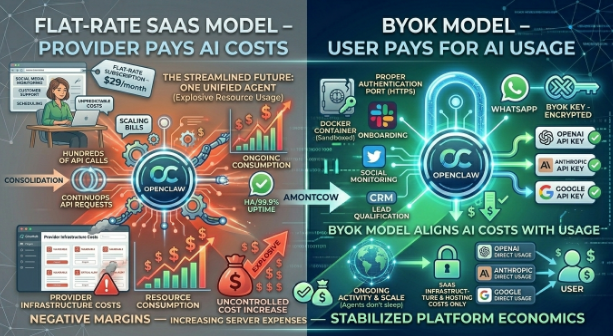
Bring Your Own Key – BYOK – is emerging as the dominant pricing pattern for AI agent platforms specifically because it solves the unit economics problem from both sides.
For the platform operator, BYOK means the most expensive variable cost – LLM inference via OpenAI, Anthropic, Google, or other providers – is paid directly by the user. The platform charges for infrastructure, hosting, and features, not for token consumption. This makes costs predictable regardless of how agdgressively the agent runs.
For the user, BYOK provides transparency. You see exactly what your agent costs in API fees because you’re paying the model provider directly. No markup. No opaque “AI credits” bundle. No surprise overages because the platform decided to reclassify your usage tier.
Managed OpenClaw hosting services have adopted this model almost universally. BetterClaw’s BYOK pricing for deployed agents, for instance, charges a flat infrastructure fee while users connect their own API keys from any of 28+ supported model providers. xCloud and ClawHosted follow similar patterns at different price points. The infrastructure is the product; the AI consumption is yours to manage.
This structure also gives users the ability to optimize costs in ways bundled pricing never allows – choosing cheaper models for simple tasks, rate-limiting agents during off-hours, or switching providers entirely without changing platforms.
Why BYOK Changes the Build-vs-Buy Calculus
Stay with me here.
If you’re a startup founder evaluating whether to self-host OpenClaw on a DigitalOcean droplet or use a managed service, BYOK fundamentally alters the comparison. In the old model, a managed service might charge you $49/month and include AI credits – making it hard to compare against the $6/month VPS cost plus your own API spend. The pricing was apples-to-oranges by design.
With BYOK, the comparison becomes transparent. Your API costs are identical either way because you’re using the same keys. The only variable is infrastructure: Do you want to manage Docker containers, YAML configurations, security patching, and uptime monitoring yourself? Or do you want to pay $19–49/month for someone else to handle that?
For a comprehensive look at what teams are actually building with deployed OpenClaw agents – from customer support automation to internal workflow orchestration – the diversity of use cases makes clear why standardized infrastructure pricing matters more than bundled AI credits. Each use case has radically different token consumption, and BYOK lets the user optimize for their specific pattern.
See also: Decoding the Tech Language of Technology-Hub
The Downstream Effects on SaaS Pricing Strategy
The agent-driven pricing crisis isn’t just an OpenClaw problem. It’s hitting every API-dependent service simultaneously.
Notion recently adjusted its API rate limits. Linear introduced agent-specific tiers. Multiple email providers have quietly added clauses to their terms of service prohibiting “automated bulk operations” that clearly target AI agent usage.
But these are band-aids. The structural shift is this: any SaaS product that exposes an API will eventually need an agent-aware pricing tier. Not a higher price for the same product – a fundamentally different pricing structure that accounts for machine-speed consumption.
The companies adapting fastest are the ones that already had usage-based components in their pricing. The ones scrambling are the ones that sold simplicity – “one price, everything included” – and are now discovering that “everything” includes being hammered by thousands of autonomous agents 24 hours a day.
What Founders and Operators Should Do Now
If you’re building a SaaS product, audit your pricing for agent vulnerability. Ask: what happens to my unit economics if 10% of my users connect an AI agent that makes 50x the normal API calls? If the answer is “our margins disappear,” you need a usage-based component in your pricing before that 10% arrives.
If you’re deploying AI agents, favor platforms and tools with transparent BYOK models. Bundled AI credits feel convenient until you’re rate-limited mid-workflow or hit with overage charges that dwarf your subscription fee. Owning your API keys means owning your cost structure. Services like Better Claw, xCloud, or even a well-configured self-hosted setup on AWS all support this model – pick the one that matches your operational capacity.
If you’re an investor evaluating SaaS companies, add “agent-resilient pricing” to your due diligence checklist. A beautiful per-seat SaaS business with 80% gross margins can see those margins compressed to single digits in a quarter if agent adoption spikes among its user base.
The Pricing Reckoning Is Just Starting
The Google Antigravity bans were a signal, not an anomaly. Every flat-rate API, every unlimited plan, every per-seat license that doesn’t account for autonomous consumption is a pricing model waiting to break.
The fix isn’t complicated. Usage-based pricing works. BYOK works. Transparent cost structures where the consumer of resources pays for resources – these aren’t novel ideas. They’re the same principles that made cloud computing financially sustainable after the datacenter era.
What’s new is the urgency. With 230,000+ stars and exponential adoption, OpenClaw alone is generating enough agent traffic to stress-test every pricing model it touches. The SaaS companies that adapt their economics now will absorb the wave. The ones that wait will find themselves choosing between banning their most active users and watching their margins vanish.
Neither option is a good look on an earnings call.