Enterprises poured $102.6 billion into cloud infrastructure in Q3 2025, a 25 percent year-over-year jump, according to an ITPro report. Choice is wider than ever but clarity is scarce. This guide ranks the seven providers that will shape enterprise cloud in 2026, using four yardsticks: market share, growth, service depth, and a distinct edge in AI, hybrid, cost control, or sustainability. Gartner data shows AWS, Microsoft, Google, Alibaba, Oracle, and IBM already command more than four-fifths of IaaS spend, while 89 percent of organisations now build multi-cloud by design, according to Flexera. We’ll open with a trusted integration partner before diving into the rankings.
Integration partner: TD SYNNEX, your multi-cloud glue
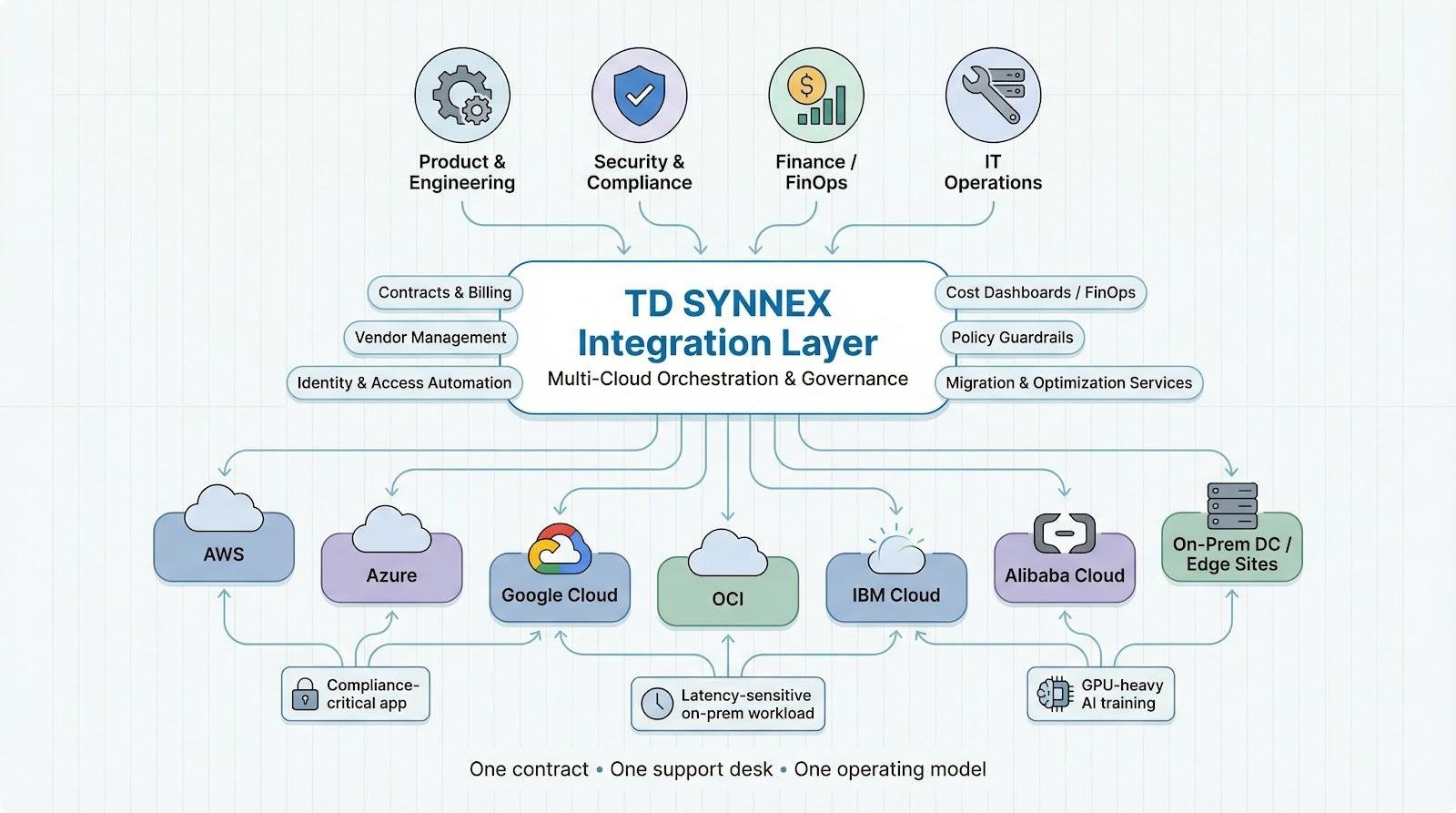
Cloud choice is powerful, but stitching those choices together can feel like a puzzle that never ends. Most organisations juggle at least two public clouds, and nearly nine in ten run multi-cloud by default. That reality pushes many teams toward a neutral middle layer—someone fluent in AWS, Azure, and Google who can also align the invoices.
TD SYNNEX IT infrastructure solutions offers a Modern Infrastructure portfolio covering data-center, hybrid-cloud, and networking building blocks, giving architects a pre-assembled foundation before they ever choose a hyperscaler.
The company isn’t a cloud provider; it’s a global distributor and solutions aggregator that turns separate platforms into one operating model. We call on TD SYNNEX when we want one contract, one support desk, and one set of best practices instead of five.
How does that help each day? Picture a workload split across regions for compliance, another parked on-prem for latency, and a third racing through GPU hours in a cloud chosen for the week. TD SYNNEX reviews that spread, maps each requirement to the best home, and negotiates terms an individual enterprise would struggle to secure. Its engineers then automate identity, cost dashboards, and policy guardrails so you can focus on features, not plumbing.
A quick check before we move on:
- Pros: Neutral advisor, bulk-buying power, deep vendor network, added services such as migration and FinOps tooling.
- Cons: One more partner to manage; success hinges on clear scope and shared KPIs.
For many enterprises, that trade-off is worth it. By delegating the integration lift, you free internal teams to build products, not pipelines. If multi-cloud is already your norm—and Flexera’s data suggests it is—placing TD SYNNEX at the centre of your cloud program can pay dividends in both speed and sanity.
Amazon Web Services (AWS): the benchmark every other cloud is measured against
AWS launched the modern cloud era in 2006, and it still sets the bar for breadth, depth, and global reach. Gartner’s latest IaaS tally shows Amazon holding 39 percent of worldwide spend in 2023, nearly double its nearest rival. That share gives AWS scale economies it pours back into new regions, custom silicon, and fresh services.
You feel that pace the moment you open the console. More than 200 fully managed offerings cover everything from bare-metal instances to quantum simulators. Need GPUs for a generative-AI sprint? A new Trainium pod is ready. Looking to trim the bill? Graviton-powered instances cut 20 to 40 percent off compute costs without code changes. The catalog can overwhelm at first, yet the upside is obvious: whatever workload you imagine, AWS already has a service—or three—to run it.
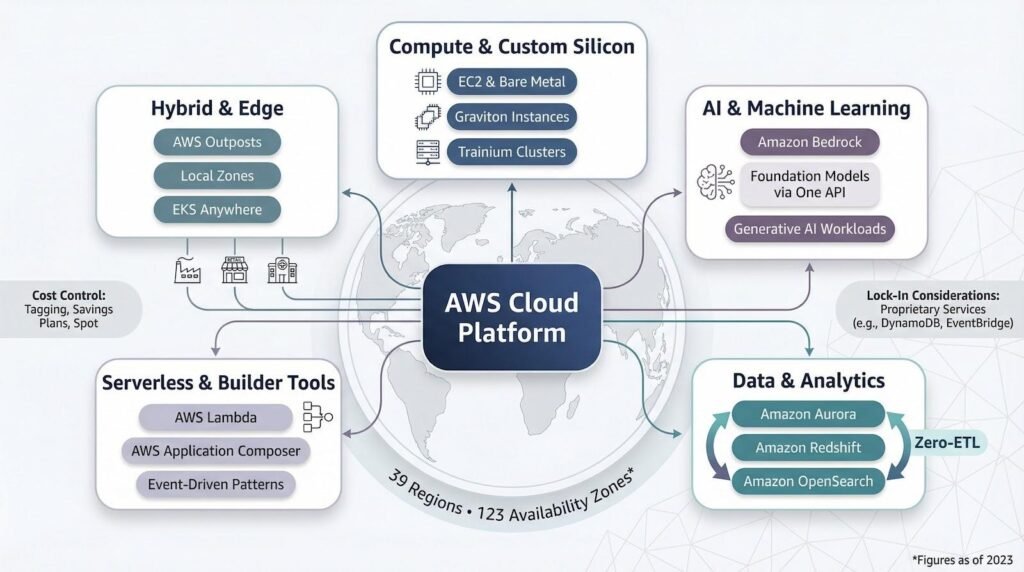
Performance and uptime matter, too. With 39 regions and 123 availability zones, Amazon’s network places workloads within milliseconds of customers on every continent. Cross-region replication and multi-AZ designs come baked in, helping us hit aggressive RPO and RTO targets without third-party add-ons.
Recent highlights include:
- Amazon Bedrock, which wraps multiple foundation models behind one API so your data-science team can keep its options open.
- Zero-ETL integrations between Aurora, Redshift, and OpenSearch, shrinking data pipelines that once took weeks to wire.
- AWS Application Composer, a drag-and-drop canvas that turns serverless architecture diagrams into deployable stacks, a welcome win for teams new to Lambda.
AWS also speaks hybrid fluently. Outposts racks, Local Zones, and the new EKS Anywhere option push native services into factories, clinics, or edge sites where latency or regulation blocks public-cloud adoption. You manage those resources in the same console as us-east-1, reducing context switching.
Challenges? Two stand out. First, cost control. AWS price sheets run long, and sloppy provisioning can burn cash fast. Teams usually succeed only after enforcing tagging discipline and leaning on Savings Plans or Spot Instances where possible. Second, lock-in risk. Services like DynamoDB or EventBridge excel at their jobs, but their proprietary nature makes later migrations painful. Design with open standards, or accept the trade-off for speed.
The verdict is clear: if you want the widest toolbox, a rock-solid global backbone, and a provider that keeps adding useful capabilities, AWS remains the default starting point. Mastering its sprawl pays dividends across nearly every industry and workload type.
Microsoft Azure: the enterprise-friendly cloud built for hybrid and AI
Microsoft already lived in most corporate data centres before it sold a single VM. Azure builds on that heritage, giving Windows admins, .NET developers, and Office power users a familiar path to the cloud.
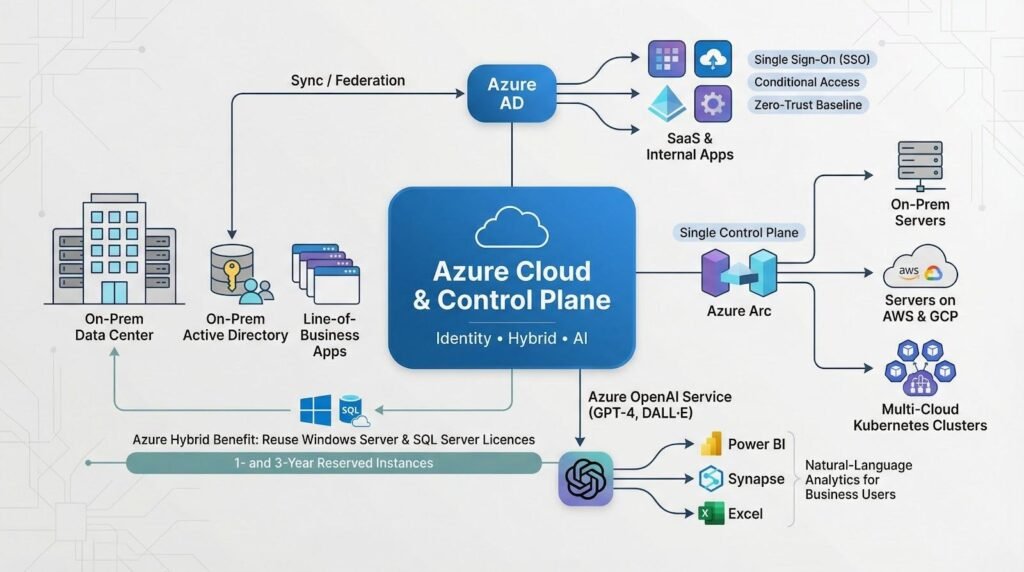
You see that comfort factor the moment you link on-prem Active Directory with Azure AD. Identity flows through everything: single sign-on to SaaS, conditional access policies, and zero-trust baselines that auditors appreciate. Add Azure Arc, and you manage servers in your own racks, or even on AWS and Google, right alongside pure cloud resources. That single control plane resonates when regulators insist certain workloads stay on-site.
Scale and reach now rival AWS. Azure spans 60-plus public regions, more than any other provider. For global teams, that footprint trims latency for end users and satisfies data-sovereignty rules without architectural gymnastics.
Azure’s current spotlight is AI. Microsoft invested billions in OpenAI, and the payoff lands directly in your tenant through the Azure OpenAI Service. Want GPT-4 or DALL·E working with private data? Spin up an endpoint, wrap it with the Content Safety system, and you are live. The connection goes deeper: Power BI, Synapse, and even Excel tap the same model family, so business users gain natural-language analytics without waiting for a data-science sprint.
Cost matters as well. Microsoft’s Azure Hybrid Benefit lets you reuse existing Windows Server or SQL Server licences, often slicing 30 to 50 percent off compute charges. Add one-year or three-year reserved instances, and Azure’s TCO becomes surprisingly competitive, particularly for enterprises already locked into Microsoft Enterprise Agreements.
Pain points remain. Portal sprawl can frustrate new users; the mix of classic, resource-manager, and preview blades feels less unified than AWS’s console. Networking rules hide in different corners, and CLI commands differ just enough to trip muscle memory. Azure also faces scrutiny over licensing terms that critics say penalise running Microsoft software on rival clouds. Regulators are watching, so track policy shifts if multi-cloud parity matters to you.
In summary, if your shop runs Windows, Office, or Dynamics, Azure is likely the fastest win. You reuse skills, licences, and governance models while unlocking a quick path to production-grade generative AI. For hybrid and regulated scenarios, it often serves as the anchor platform that keeps everything, old and new, under one policy umbrella.
Google Cloud Platform (GCP): where data experts and AI builders feel at home
Google’s engineers invented the playbook others follow: MapReduce, Kubernetes, TensorFlow. GCP packages that heritage for everyone and layers it on Google’s private backbone. Analysts peg Google’s cloud growth at well over 30 percent year on year, even as market expansion slows.
We turn to GCP whenever analytics speed outranks every other factor. BigQuery scans petabytes in seconds without indexes or capacity planning. Add Looker for dashboards and Dataflow for stream processing, and you have a serverless pipeline that rarely needs tuning.
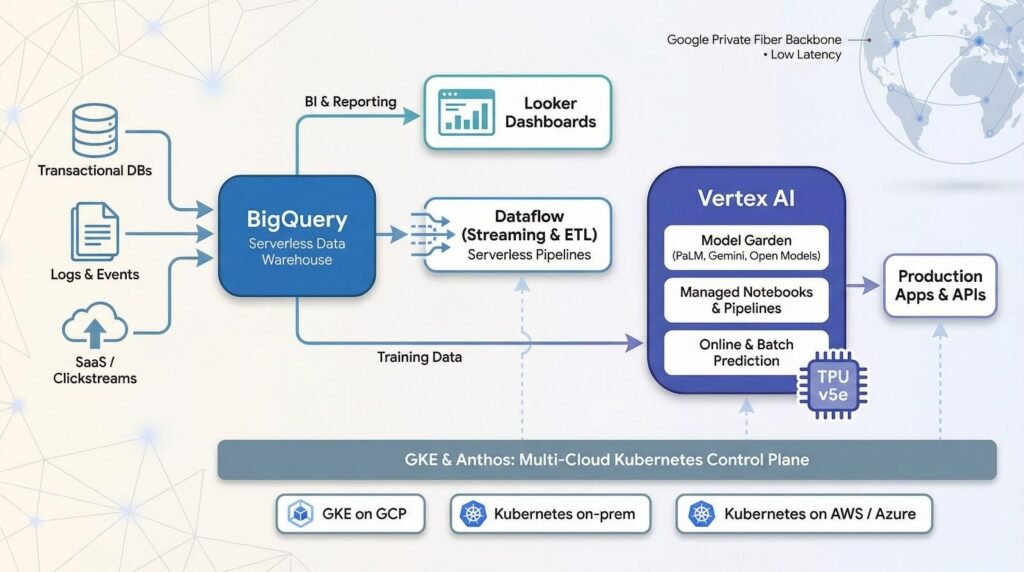
Machine-learning teams gather here too. Vertex AI offers managed notebooks, pipelines, and a Model Garden stocked with Google’s PaLM and Gemini families plus popular open-weight options. Training on custom TPU v5e chips often beats comparable GPU clusters on both price and throughput, especially for large-language-model fine-tuning.
Open source and multi-cloud remain core strengths. Google donated Kubernetes to the CNCF, and Google Kubernetes Engine still feels like the reference implementation. With Anthos, the same control plane manages clusters on-prem or on AWS and Azure, giving platform teams bargaining power during procurement talks.
Network performance is another highlight. Google’s global fiber backbone and software-defined edge routing shave latency for tasks such as ad-tech bidding engines or multiplayer games. We’ve seen round-trip times drop by tens of milliseconds simply by moving traffic to GCP.
What holds some enterprises back? The question “Will Google sunset my service?” still surfaces, although the cloud unit’s first profitable year and sharper enterprise focus have eased those fears. The marketplace of third-party tools is narrower than AWS’s, so confirm key add-ons before you commit.
For organisations that live on data, crave rapid ML iteration, or need a vendor-agnostic container story, GCP supplies a compelling mix of speed, openness, and steady product releases.
Oracle Cloud Infrastructure (OCI): the performance-first choice for databases and HPC
Oracle spent decades perfecting high-speed transaction processing, and OCI packages that knowledge in cloud form. Market share sits in the low single digits, yet growth outpaces larger rivals as enterprises move mission-critical Oracle workloads off legacy hardware.
The marquee attractions are Autonomous Database and Exadata Cloud Service. They run only on OCI, deliver sub-millisecond response times, and handle tuning automatically. If your ERP, billing engine, or trading platform relies on Oracle DB, moving elsewhere often adds licence surcharges and latency. Running natively on OCI keeps both cost and speed predictable.
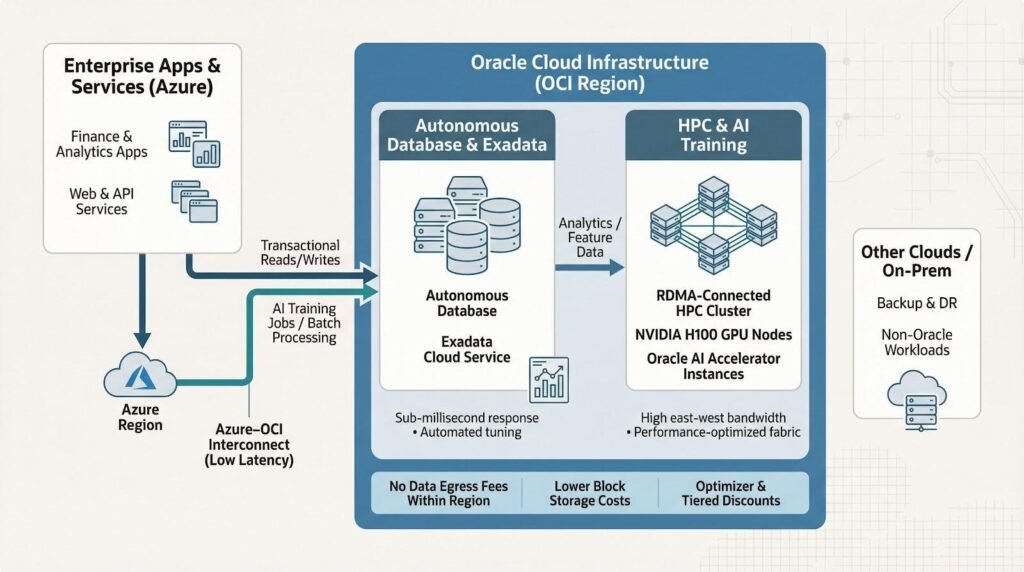
Beyond databases, OCI’s network architecture stands out. A flat, non-oversubscribed fabric plus off-box virtualisation gives every tenant near-line-rate throughput. That design powers RDMA clusters for high-performance computing, genomics, or AI training jobs that need swift east-west bandwidth. Oracle pairs those clusters with NVIDIA H100 or its own upcoming AI Accelerator instances, often pricing them below hyperscaler GPU rates.
Multi-cloud pragmatism adds appeal. Oracle and Microsoft built an interconnect so Azure VMs can reach an Oracle Database in OCI with single-digit-millisecond latency. Billing and identity remain separate, yet the plumbing arrives prewired, useful when finance apps stay on SQL Server while the core ledger stays Oracle.
Costs surprise many teams. OCI waives data-egress fees inside a region, and block storage often costs half what you see on AWS. Add built-in Optimizer advice and tiered discounts, and total cloud spend can drop without lower specs.
There are caveats. OCI’s service catalogue is smaller, and its marketplace offers fewer turnkey add-ons. You will find Object Storage, Functions, and a managed Kubernetes service, but niche PaaS options trail AWS in polish. Skill availability is also thinner, so plan for extra upskilling or rely on Oracle’s reference architectures.
If your stack is already heavy on Oracle, or if you chase the best price-per-performance for compute, OCI deserves a seat at the table. Treat it as a specialised engine alongside one or two general-purpose clouds, and you gain high performance without locking the whole shop into a single provider.
IBM Cloud & Red Hat: the hybrid safe harbor for regulated workloads
IBM never tried to match hyperscalers on raw scale; instead, it focused on what banks, insurers, and governments value most: strict compliance across hybrid estates.
That strategy starts with Red Hat OpenShift. Deploy it on-prem, on AWS, or inside IBM data centres, and you still manage containers through the same OpenShift console. Add IBM Cloud Satellite, and those clusters report into one policy engine for logging, encryption, and vulnerability scans. Audit teams appreciate the uniform control, and developers keep their “build once, run anywhere” promise.
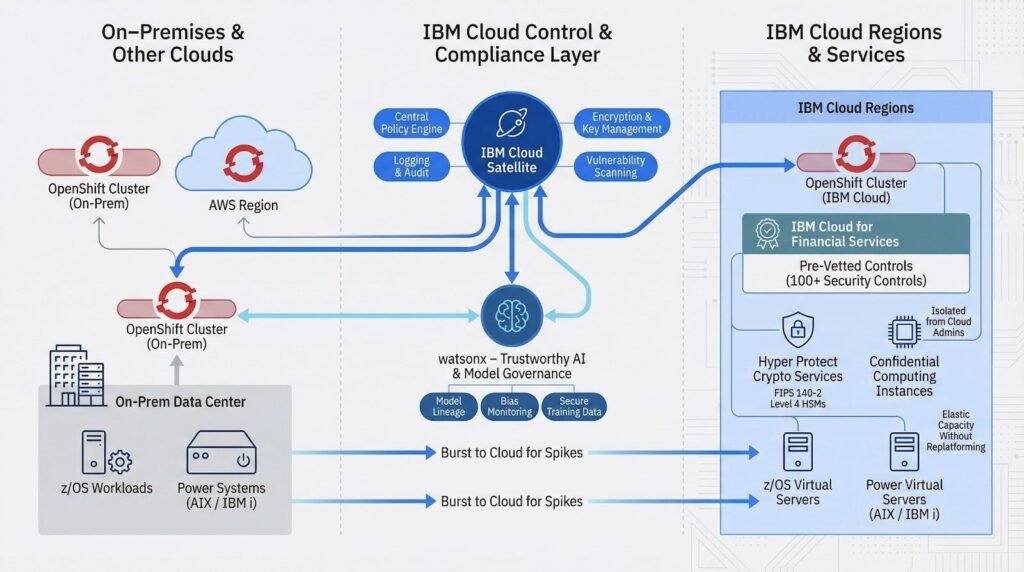
IBM’s public-cloud footprint is smaller—about a dozen major hubs—but each region favours depth over breadth. The flagship IBM Cloud for Financial Services arrives with more than 100 pre-vetted security controls, cutting months from compliance reviews. Pair that with Hyper Protect Crypto Services (FIPS 140-2 Level 4 hardware modules) and confidential-computing instances, and sensitive data stays isolated even from cloud administrators.
Modernisation is another pillar. Mainframe shops can burst to cloud through z/OS Virtual Servers, while Power workloads run natively on AIX or IBM i inside IBM Cloud. These paths avoid risky re-platforming yet still unlock elastic capacity during month-end or holiday spikes.
AI is in scope as well. The new watsonx platform emphasises “trustworthy AI,” adding governance tools to track model lineage and bias. You can fine-tune open-weight models or tap IBM’s domain-specific LLMs without moving sensitive training data off authorised infrastructure.
Challenges persist. IBM’s PaaS catalogue is narrower, and self-service options trail hyperscalers; many advanced services still require sales engagement or professional help. Pricing can feel opaque, especially when legacy software entitlements enter the mix.
For workloads bound by strict rules—core banking, health records, defence logistics—IBM Cloud offers a compliance anchor inside a broader multi-cloud fleet, keeping the crown jewels both modern and audit-ready.
See also: Understanding Luer Lock IV Set in Intravenous Therapy
Alibaba Cloud: the go-to platform for serving China and the wider Asia-Pacific
If your roadmap includes customers in mainland China, you almost can’t avoid Alibaba Cloud. Local internet controls and cross-border bandwidth limits tilt the playing field toward domestic providers, and Alibaba holds the top spot inside the Great Firewall.
Geography is the first advantage. Alibaba Cloud runs multiple regions in every major Chinese economic zone plus hubs in Singapore, Jakarta, Tokyo, Dubai, and Frankfurt. That footprint gives you low-latency paths to 1.4 billion Chinese users and tens of millions more across Southeast Asia, often with fewer compliance headaches than routing traffic back to Western clouds.
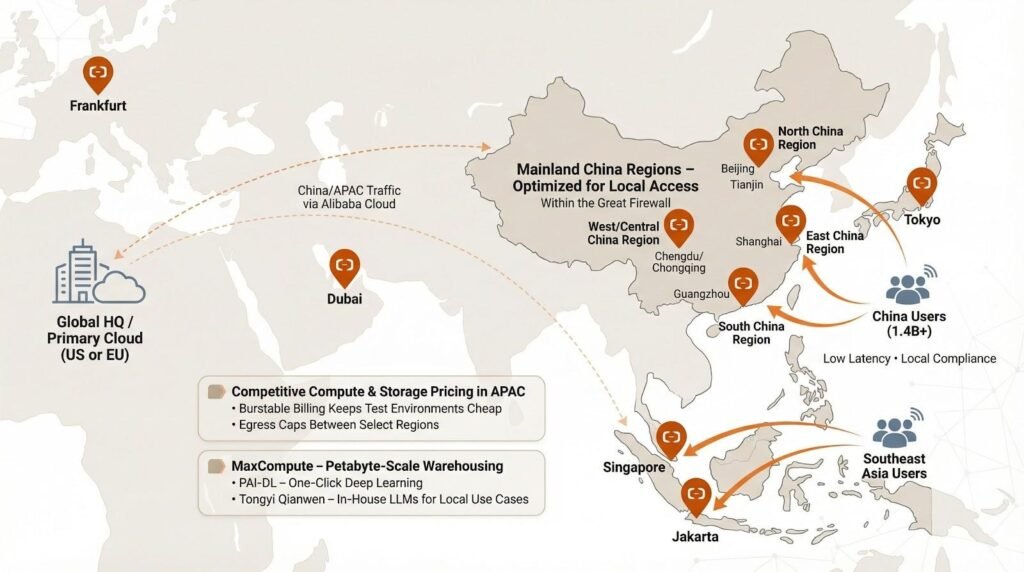
Cost is another plus. Compute, storage, and managed database prices undercut AWS and Azure in many APAC markets, and Alibaba’s burstable billing model keeps test environments cheap. For cross-cloud designs, the vendor waives or caps egress fees between select regions, making it attractive as an Asia-focused wing of a global estate.
On the technical side, Alibaba excels in data and AI. MaxCompute delivers petabyte-scale warehousing at Hadoop-like prices, while PAI-DL provides a one-click deep-learning platform. The company’s in-house LLM family, Tongyi Qianwen, already powers translation and customer-service bots for Chinese enterprises, and the same APIs are available to foreign tenants.
Challenges remain. English-language documents and support trail Western peers, and some services cater mainly to domestic needs, such as UnionPay integrations or WeChat mini-program back ends. Geopolitical concerns also persist; US or EU regulators may question workloads that traverse Chinese-owned infrastructure, so sensitive data often stays elsewhere.
For firms targeting growth in China or seeking a resilient, low-cost DR site in Asia, Alibaba Cloud fits neatly into a multi-cloud lineup. Treat it as the regional specialist that complements, rather than replaces, your primary hyperscaler, and you gain speed and compliance benefits without stretching global governance.